✕
Create a free account to see live performance
SEC rules require us to show performance inside a logged-in account.
Every strategy runs live. Inside, you see every holding, every trade, and every move to cash.
SEC rules require us to show performance inside a logged-in account.
Every strategy runs live. Inside, you see every holding, every trade, and every move to cash.
A trading bot follows code. An AI trading agent follows instructions in plain language and can act on its own. Here is how they differ, and why both are only as good as the rules behind them.
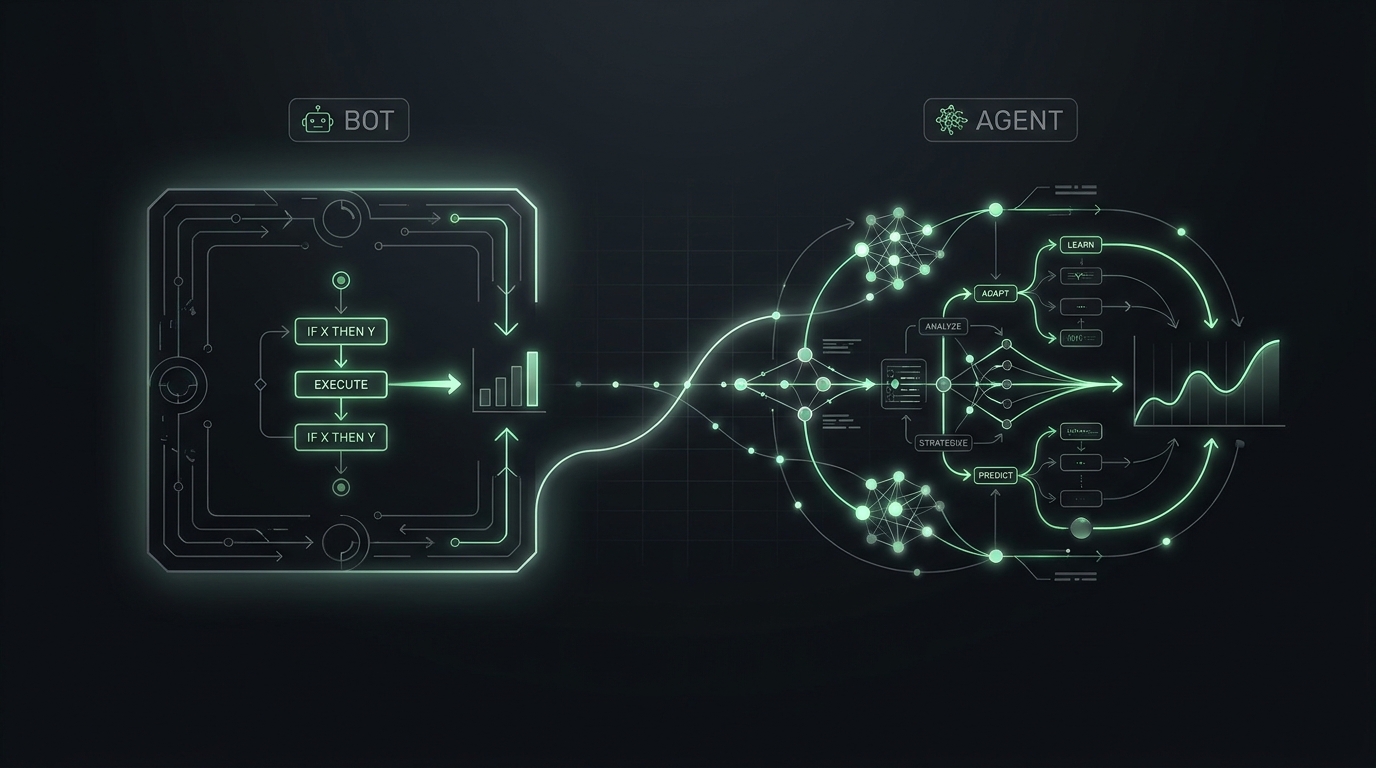
A trading bot follows code. An AI trading agent follows instructions in plain language and can take actions on its own. Both are only as good as the rules behind them.
A trading bot is software that places trades by following fixed instructions. A person writes the rules in code or settings. One example: "buy when the price falls 5% below its 20-day average."
Some bots use a machine learning model trained on past data instead of hand-written rules. Either way, the logic is set before the bot runs. Feed it the same data twice and it makes the same choice twice.
An AI trading agent is a chatbot, such as Claude or ChatGPT, connected to a brokerage so it can act. You give it instructions in plain language. It reads your account and market data, then places orders.
FINRA is the Financial Industry Regulatory Authority. It says AI agents can plan, make decisions, and take actions toward a goal. That ability to act is what makes it an agent, not just a chatbot.
A trading bot makes more sense when you want exact, repeatable behavior. Because the logic never changes on its own, you can test it on past data and expect the same behavior live.
The trade-off is rigidity. A bot cannot handle a situation its rules did not plan for. And building one usually takes some coding or a bot-building tool.
An AI agent makes more sense when you want plain-language setup and an assistant that can explain itself. You can tell it what to do without writing code.
The trade-off is consistency. A chatbot writes a fresh answer each time, so the same request can lead to different trades. FINRA also lists hallucinations, or confident false statements, as a risk of AI agents.
Both need good rules because neither one can create a reliable strategy by itself. The CFTC, the Commodity Futures Trading Commission, warns that AI cannot predict the future or sudden market changes.
The strongest setup often combines the two ideas. Fixed, tested rules decide what to hold, and an AI agent carries out the orders.
As Portfolio Lab puts it, language models read, explain, and execute. They don't decide.
For the evidence on why many bots fail testing, read do AI trading bots actually work?
There is no single best AI trading bot. A good one, of either kind, passes these checks.
The SEC, FINRA, and state regulators warn about tools that claim AI powers them without real substance, a practice they call AI-washing.
A free tool can be fine for learning, but price says nothing about how well it is built. Check who runs it and where your money sits before you connect anything. Be wary of any tool that asks you to send money to its operator.
Portfolio Lab is a strategy research and simulation tool from alphaAI Capital. It lets you build investment strategies and test them in live markets with virtual money. You can connect it to AI apps like Claude or ChatGPT, so your agent has a strategy's plan to follow.
There is no single best one. The best fit follows tested, written rules, trades in your own account, and never promises returns.
No. A bot follows fixed code. An agent is a chatbot that reads plain-language instructions and takes actions.
Both carry risk. Bots are more predictable. Agents are more flexible but can misread instructions.
Yes, some tools are free to start. Check who runs them and where your money sits before using one.
It can act as an AI agent when connected to a broker that supports it. It follows your instructions, not a built-in strategy.
Some follow their rules well, but none can predict the market. Most fail in testing because of overfitting or costs.
Bots often need code or a bot builder. AI agents usually need only an AI app and a broker connection.
Build, test, and deploy your own strategies in Portfolio Lab. Free to start.
Educational & Research Disclosure: The content provided is for informational and educational purposes only and is not intended to constitute investment advice, a recommendation, solicitation, or offer to buy or sell any security. Any discussion of market trends, historical performance, academic research, models, examples, or illustrations is presented solely to explain general financial concepts and does not represent a prediction, guarantee, or assurance of future results. Past performance is not indicative of future results. All investing involves risk, including the possible loss of principal.